
Key takeaways
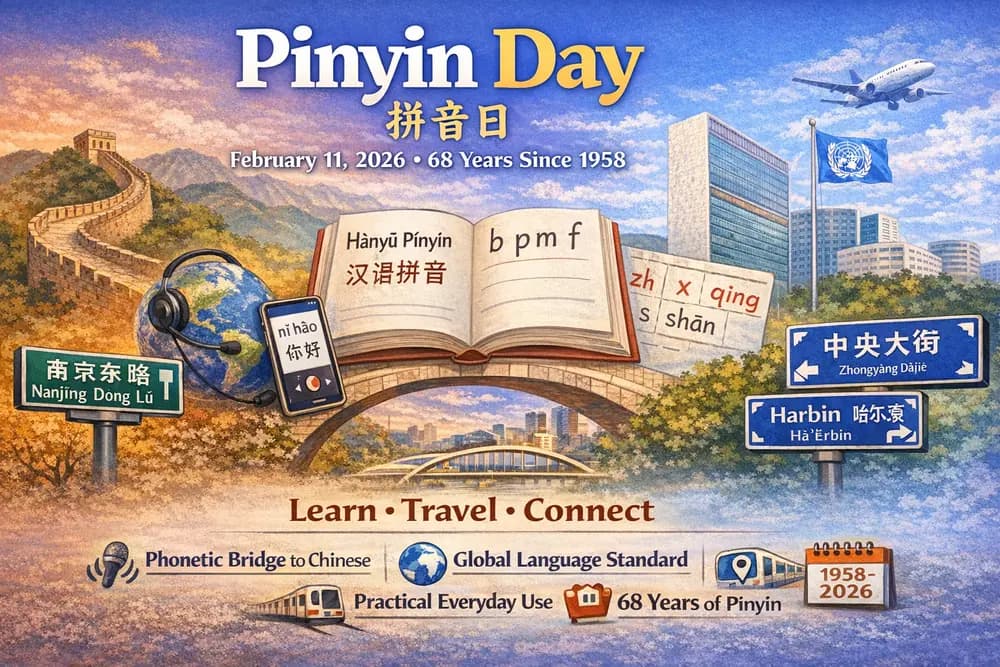
- Feb 11, 1958 — China's NPC approved the “Scheme for the Chinese Phonetic Alphabet” (Hanyu Pinyin Fang'an).
- Feb 11, 2026 — that makes 68 years.
- Pinyin became a global standard through UNGEGN (1977) and ISO 7098 (current edition: 2015).
- It is the fastest way to bootstrap pronunciation and the default method to type Chinese via pinyin input.
Why February 11 is associated with Pinyin Day
February 11 is a clean reference point because this is when the pinyin system was officially approved in 1958.
“Pinyin Day” is not an official global holiday. It is a practical reminder that pinyin is not a beginner shortcut, but a standardized tool that connects education, research, and technology.
Pinyin did not replace Chinese characters. Instead, it became a bridge between speech and writing: it helps you hear and produce sounds accurately, then move into tones, vocabulary, and characters.
Context
Rule of thumb: use pinyin for pronunciation and typing, but progress accelerates when you practice tones + listening + characters in parallel.
Timeline: how pinyin became a global standard
A compact view of the milestones that took pinyin from a domestic reform to international standardization:
| Year | Milestone |
|---|---|
| 1957 | China's State Council approved the draft and submitted it to the NPC. |
| 1958 | The NPC officially approved pinyin. |
| 1977 | UNGEGN (Resolution III/8) recommended pinyin for Chinese geographical names in international usage. |
| 1982 / 2015 | ISO standardization: ISO 7098 (current edition: ISO 7098:2015). |
| 2000 | The Library of Congress and many U.S. libraries adopted pinyin as the primary romanization standard. |
Note: pinyin describes Standard Mandarin and does not represent every Chinese dialect equally.
UN context (2025-2026): where pinyin fits
The UN has an official date tied to the Chinese language: April 20 (UN Chinese Language Day). The initiative started in 2010 to support multilingualism.
According to Chinese state reporting for the 2025 cycle, events were hosted by 1,000+ organizations across 50+ countries. This highlights the scale of global interest, with pinyin often acting as the practical entry point for learners.
Why pinyin still matters in 2026
1. Fast phonetics onboarding
Pinyin lets you start reading syllables quickly and work on pronunciation from day one.
2. Standardization across education and tech
Dictionaries, catalogs, maps, transit systems, and mobile keyboards rely on pinyin as a shared format.
3. Immediate value for travel in China
Even basic pinyin helps you navigate metro stations, airports, and road signs where Latin letters appear alongside characters.
4. A foundation for long-term mastery
Pinyin is foundational, not final. It does not replace tones, characters, or context, but it dramatically lowers the initial barrier.

Pinyin on signs makes navigation easier: stations, streets, and directions are often labeled in Latin letters.
Beginner pitfalls to avoid
- Pinyin is not “Chinese written in Latin letters” in a full sense. It is a phonetic system for Standard Mandarin.
- Tones are essential: the same syllable can represent different words depending on tone.
- Letters do not map to English sounds: for example,
q,x,zh, andcbehave differently than most learners expect.
Quick drill: say the four tones on ma (mā, má, mǎ, mà) to feel how meaning changes.

A syllable table helps you practice initials and finals systematically (for example, j/q/x and zh/ch/sh).
How to mark Pinyin Day: a 20-minute routine
- Review tricky sound groups:
j/q/xandzh/ch/sh(5 min). - Practice 20-30 syllables in 4 tones + neutral tone (7 min).
- Compare 20 Chinese place names: characters + pinyin (4 min).
- Type 5-7 short sentences using pinyin input (4 min).
FAQ
Does pinyin replace Chinese characters?
No. Pinyin supports pronunciation, dictionary search, and typing, but reading and writing ultimately depend on characters and context.
Can I learn without tones?
You can, but it slows you down. Tones are part of meaning: the same syllable with different tone can be different words. Introduce tones early in small daily practice.
Why do letters sound different than expected?
Because pinyin encodes Mandarin sounds, not English spelling rules. The most reliable approach is to learn with audio and a trusted pronunciation reference.
How do I start typing Chinese with pinyin input?
Enable a pinyin keyboard on your phone/PC, type syllables in Latin letters, and pick characters from suggestions. At the beginning, you can type without tones; most systems disambiguate by context.
Sources
- Resolution of the National People's Congress on the Scheme for a Chinese Phonetic Alphabet (1958)
- State Council Resolution on Draft Scheme (1957)
- UNGEGN Working Group: Resolution III/8 (1977) on Chinese names in pinyin
- ISO 7098:2015 — Romanization of Chinese
- Library of Congress: U.S. libraries adopted pinyin (2000)
- UN Geneva: Chinese Language Day (April 20)
- UN: Why April 20, historical context, UN language policy
- State Council (2025): global Chinese Language Day events
- Wikimedia Commons photo: Shanghai signboard
- Wikimedia Commons photo: Harbin traffic signs
- Wikimedia Commons image: Standard Chinese Pinyin Table
Important